


In the National Energy System Plan (NPE), the government rightly opts for a realistic energy transition. Both electrons and molecules will remain essential. Dutch gas production must be maintained during the transition to safeguard security of supply, while CCS is necessary for the decarbonisation of our industry. At the same time, the government identifies faster procedures as necessary to close the gap between ambition and delivery. These conclusions now need to be brought together. Dutch gas production and CO₂ storage should therefore be given the same procedural urgency as other essential energy transition projects.
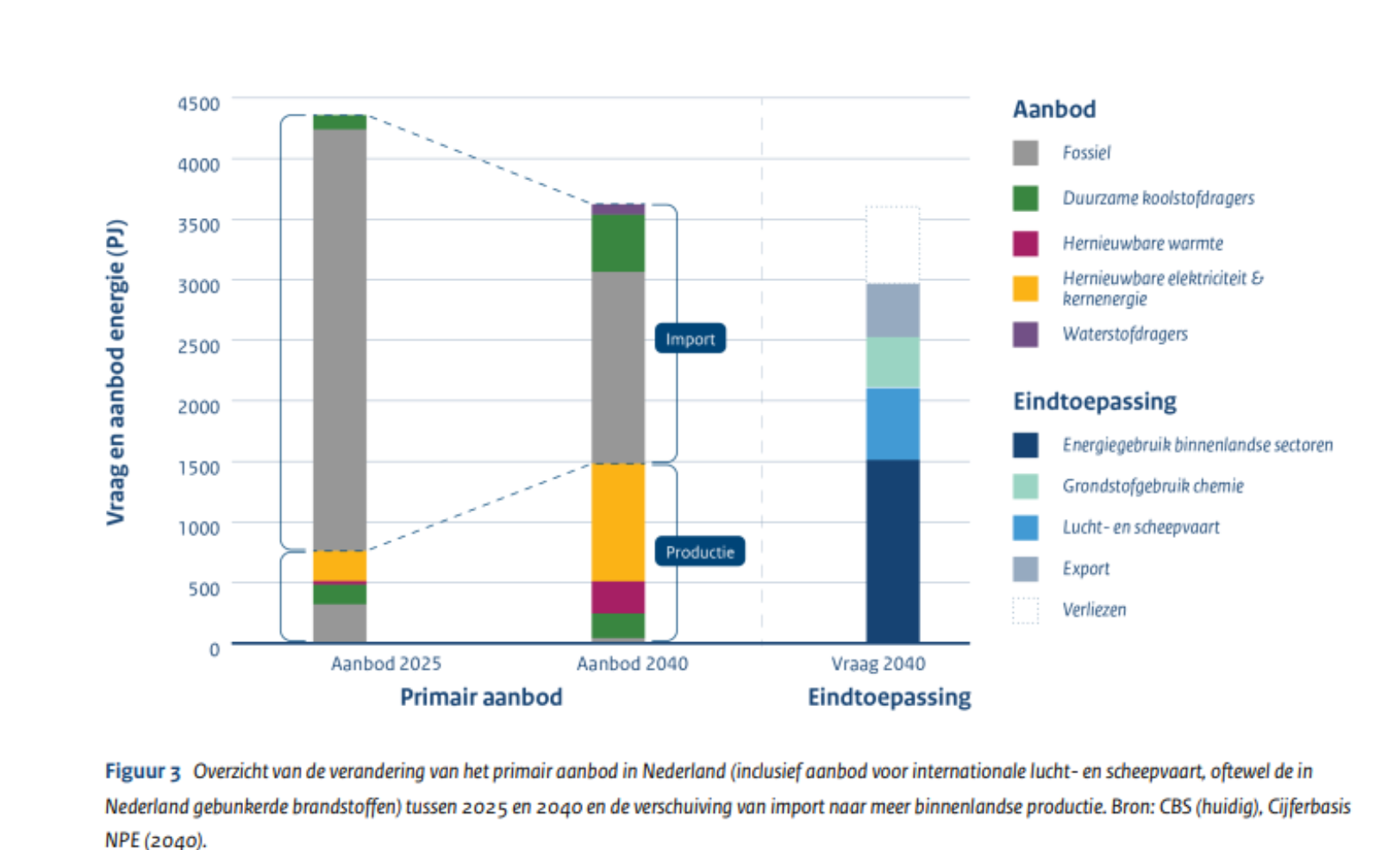
The updated NPE 2050 places greater emphasis on implementation and the resilience of the Dutch energy system. Resilience and energy independence are becoming increasingly important. The government states that by 2040, the share of imported energy should fall from 84% to slightly less than half. The role of domestically produced energy will therefore naturally become more important.
To achieve this, the government aims to maintain domestic gas production with a view to security of supply and reducing the climate impact of our gas consumption, as set out in the Sector Agreement on Gas Production in the Energy Transition, concluded last year between the Minister of Climate and Green Growth, Element NL and Energie Beheer Nederland. Element NL supports these ambitions and objectives and therefore calls on the government to make implementation of the Sector Agreement an integral part of its 2026-2029 policy agenda and to incorporate the milestones of the Sector Agreement into the NPE.
Role of natural gas
In the updated NPE, the government emphasises that the availability and affordability of oil and gas are essential during the energy transition. Building a climate-neutral energy system is necessary, but also involves uncertainties. To mitigate the impact of these uncertainties on energy affordability and security of supply, sufficient energy must remain available. In 2025, natural gas accounted for around 36% of primary final energy consumption in the Netherlands. According to the ministry's projections, this will still be around 28% in 2040. The role of renewable electricity is growing, but natural gas will remain an important energy source for industry, weather-independent electricity generation and the heating of homes. To limit dependence on imported natural gas as much as possible, sufficient new domestic gas production needs to be brought online.
Import dependence and energy independence
The ministry emphasises that a resilient energy system is a prerequisite for safeguarding the reliability and affordability of energy. Energy independence is an important dimension of this. The government aims to reduce dependence on energy imports while at the same time stating that Dutch gas production should be maintained during the transition. As long as the Netherlands continues to use natural gas, it is therefore not only the amount of gas that matters, but also where that gas comes from.
This underlines the need for swift implementation of the Sector Agreement, allowing new gas production to slow the decline in domestic production. Accelerating permitting procedures and shortening objection and appeal procedures are crucial. This also provides an opportunity to expand the Jetten I government's policy agenda to include accelerated procedures for natural gas and CO₂ storage projects. The government could extend its approach to tackling grid congestion to these projects.
Energy transition and CCS
The government is clear about the role of CCS: CO₂ storage is necessary to achieve Dutch and European emission reduction targets, particularly for the decarbonisation of industry. The government aims to ensure the timely development of underground storage capacity. EUR 1.3 billion has already been committed to the required infrastructure. However, developing a well-functioning CCS value chain requires attention not only to storage and infrastructure, but also to CO₂ capture. Investment certainty for companies is essential, and the timelines for the different parts of the value chain need to be properly aligned.
One of the government's planned actions on CCS is to have the Aramis CO₂ infrastructure project operational by 2030. The government considers this a prerequisite for scaling up the CCS value chain in the Netherlands.
Element NL emphasises that several other CO₂ storage projects are planned in the Netherlands, all of which contribute to the 50 Mtpa storage capacity target under the Net-Zero Industry Act (NZIA). The cumulative obligation for companies operating in the Netherlands exceeds the envisaged 7.5 Mtpa storage capacity referred to by the government in the updated NPE. All CO₂ storage projects are therefore necessary to achieve Europe's ambitions. Finally, sufficient volumes of captured CO₂ will also be required.
Element NL therefore calls on the government to develop the CCS value chain in an international context.


